


Smart miniature drug delivery systems - Patent landscape

Full text: The key to future patent searches

Shall we say the era of complete information disclosure has just begun? and hence the importance of full text patent searching. This blog post is subsequent to our recent post where we cited a classic patent suit where the ‘test of enablement’ was exercised.
Under section US112, the test of enablement requires the claims to be backed by full disclosure of the preferred embodiment in the specification. This tactic has been used by lawyers extensively to invalidate patents in the courts of law.
Hence, as a commercial information service provider the provision of the full text data becomes extremely important to search and analyze since the import of the inventive step may not be fully available from the claims.
In other words, there is potent challenge to perform a thorough patent search given the commercial patent database providers providing just the thumb nail view of the first page. My random informal meetings with Dolcera’s analysts go on to concur on one simple fact that in order to understand the utility of an invention, it is highly advised that a patent search is done on the full specifications of the patent.  They believe that the title, abstract and claims typically make one to understand the novelty and non obviousness while most patents have their utility residing in the full specification.
Further, it is only prudent to have a thorough patent search involving full specifications of the patents where the purpose of patent search is for litigations involving invalidation / infringement and also while searching the prior art. Time and again, it has become a thumb rule for a patent searcher to understand that the patents are often written with a purpose to obscure the patented invention.  We believe that the above reiterates the need to search on the full text and hence the key for future patent searches.
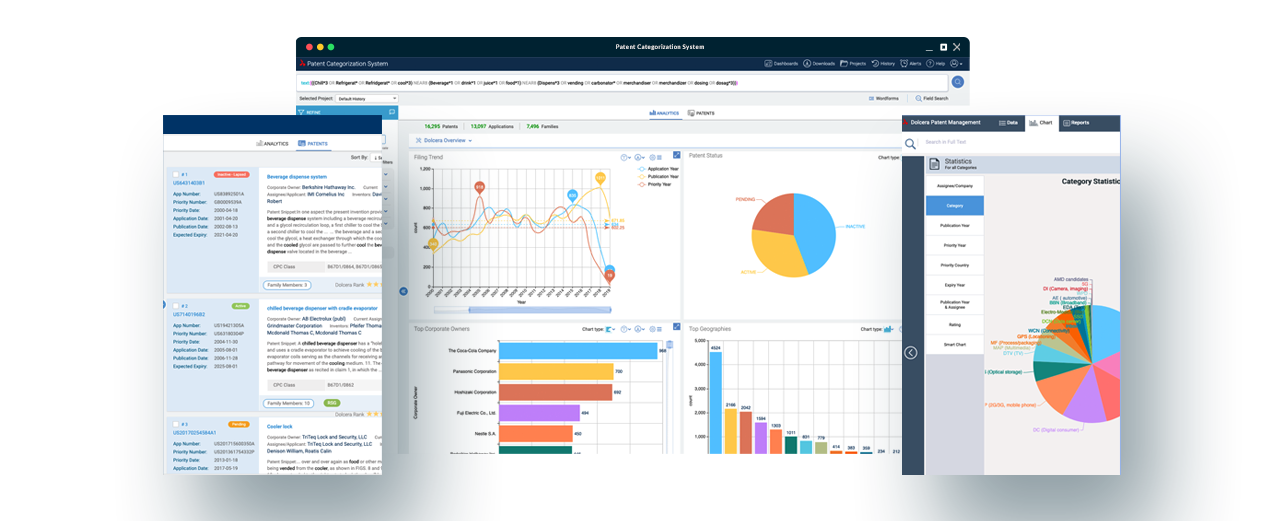
Alternately, the patent dashboard’s new version allows searching the full text of the patent even with simple boolean operators. The search snippets provided beside the pdf documents of patents is where the searched keyword is highlighted on the full text.

[Post to Twitter] Tweet  [Post to Delicious] Delicious  [Post to Digg] Digg  [Post to Facebook] Facebook 

What does the Dolcera dashboard sit in the family of patent tools?

“Is it a bird, is it a plane…” What is the Dolcera dashboard and how does it fit into the constellation of other patent products? Three types of patent applications have been available to IP professionals over the years:
  1. Patent search engines: In this category, we have the Thomson tools (Micropatent, Delphion, Thomson Innovation), Questel, Lexis-Nexis, Google Patents, and the patent office’s own search tools (USPTO’s search engine, eSpaceNet, etc.).
  2. Patent analytics tools: In this category, we have the desktop tools (VantagePoint, for example), and the online tools such as Aureka, Innography, and PatentInsight Pro.
  3. Intellectual asset management systems: In this category, we have FoundationIP, IPMaster, Anaqua, and many others.
Patent professionals and other patent-aware professionals (inventors, scientists, business development/licensing managers) need tools for the following tasks:
  1. Search: Conducting patent searches on patent databases around the world.
  2. Categorization: Organize patent data (one’s own patents or competitors’ patents or those of a potential acquisition) into categories and groups that can be used for easy access to patent information.
  3. Analysis: Analyzing large quantities of patent information to understand trends and to make business decisions.
  4. Sharing/Presentation: Share “raw” patent data and the analysis with large teams of people.
  5. Collaboration: Obtaining feedback from other stakeholders in the organization, or from partners and collaborators (outside counsel, for example) on the patent data.
  6. Docketing: Tracking one’s own portfolio through the prosecution process and beyond.
The existing products do a good job of search, analysis, and docketing processes. While categorization, sharing/presentation, and collaboration are equally important aspects of the patent world, they are underserved by the tools described above. Enter the Dolcera dashboard. The dashboard focuses on the three tasks: patent categorization, patent sharing/presentation, and collaboration. With the dashboard, these three tasks are a breeze: you can take your patent sets and categories, organize patents into the categories, share the results with an interactive presentation platform, and collaborate with your colleagues easily. The dashboard is the Facebook of patents, and not the Google search engine. Dolcera also provides high quality patent search and analysis services as well, using some of the excellent search tools described above, as well as using some of our internal proprietary technologies.

Tweet links powered by Tweet This v1.4.1, a WordPress plugin for Twitter.