



Oct 18 2009

Ranking Patents on a Scorecard

Posted by Harit Mohan

Ranking makes life easier. Be it top 10 companies, top 10 universities to study technology or to choose amongst top 10 sci-fi movies you want to watch on the weekends; ranking allow us to choose the best amongst the available. Time saver, decision influencer and extremely helpful are the ranked material.

At Dolcera, we thought of applying the ranking methodology to patents. We have ranked patents based on a variety of parameters. First factor amongst all remains the client focus, second, sufficiency of disclosed information in patents and third credibility of a patent to perform the same process/art with higher efficiency than any other patent with similar focus.

Let us consider an example, the first table in the image below show patents with similar focus of decreasing tumor volume using RNA interference (RNAi). The patent one has disclosed maximum information in this area and in addition to the desired data, it has also published a lot more supporting information derived from other experiments. Further, as the rank goes down the percentage decrease in tumor volume decreases. Some may argue that patent 2 has disclosed more decrease in tumor volume than patent 1 but then patent 1 has disclosed more supporting data, taking its overall weighted score higher. Of course, if the client is still interested only in comparing tumor volume, patent at rank 2 will come at rank 1. Hence the ranking is customized to suit the client requirements.

rnai-image.png

The ranking of patents is not that simple as it may sound. The analysis team has to encounter challenges and figure out the ways to overcome them. Graphs, charts, instrumental outputs etc. will not give you data in percentages which can be just copy-pasted to compare. They have to be calculated first using mathematical tools which may vary from calculating areas under the graphs or applying differentiation & integration on instrumental outputs, to allow the reader to compare results before making the final decision. It’s considered an absolute value add to the decision making process by the clients who have sought such a service from us.

Not all experimental data will be quantitative. For people familiar with biotechnology would know that there are experiments (such as gel electrophoresis, staining etc.) that give qualitative or quasi-quantitative results. I am sure, the same will hold true with other technology fields too. Second part of the figure above summarizes few patents which can not be ranked as there is no data yield from such experiments and hence comparison is not possible. But then why miss them? We provide a Dolcera summary table which will give reader an idea as these experiments were atleast conducted and disclosed in patents. This comparison will thus strengthen the decision to be taken from ranking matrices discussed above.

This systemic approach of collecting, sorting, analyzing, and finally ranking the data has the following advantages:

1. Saves time!
2. Easy comparative analysis.
3. Helps in competitive watch
4. Decision on in-and-out licensing can be made.
5. Strong baseline for future scientific investigations.

Who will be benefited?

Scientific community: Extensive experimental data, comparison matrix of data from different patents with same focus is a feast to researchers and scientists as it helps them to choose best technologies.

Patent attorneys: Allows competitor watch, supports their decision on in and out licensing.

Venture capitalists / investors: Patent ranking based on disclosed information helps investors to decide patents to further invest upon.

Which technology fields are covered?

Patents in all the technological fields can be ranked. You just need to tell us the focus area and we will rank the patents for you. The ranking and weighing scores can be customized to suit user’s requirements.


[Post to Twitter] Tweet This Post  [Post to Delicious] Delicious This Post  [Post to Digg] Digg This Post 

Oct 07 2009

Early warning system for patent trolls

Posted by Manikandan

Call them “patent terrorists” or “paten trolls” they are here to stay. It needs constant vigil and dexterity in analyzing patents to shield those companies that have no tangible assets, products or customers—just a team of lawyers who write demand letters, file lawsuits and watch the dollars roll in. And the trolls are only one of the hosts of issues in-house IP counsel are dealing with right now as IP comes to the forefront of business law. Hence the oft repeated slogan “prevention is better than cure” holds well even in this context.

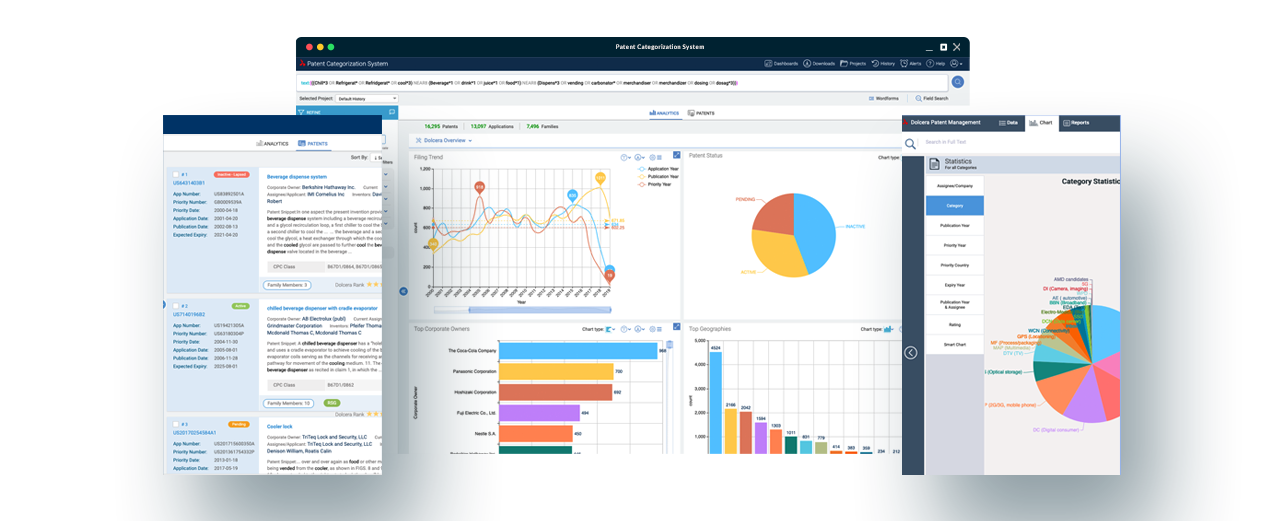
A quick mention of Dolcera’s patent dashboard is worth mentioning here. The patent dashboard has served as an early warning system for the in-house legal professionals of many Fortune 500 and Global 1000 organizations.

Most of these professionals would acknowledge that the lack of prior art information has led to any patent troll case. The patent dashboard’s collaborative feature makes it possible for sharing the prior art / product clearance searches within the organization.

Further, a regular analysis of patent portfolios of the known trolls within the industry and any closely-related industries can be pivotal in the prevention of a troll impact. The use of patent dashboard during the product design stage can ensure that all patents held by a known patent troll cannot be asserted in good faith against the products. In addition to this prevention measure, organizations can be well informed with the opinions on these patents held by patent trolls. Unlike many other contemporary tools, patent dashboard has been developed with active inputs from legal professionals from various organizations.

The issues sighted above are to prevent any possible attack from a patent troll; hence the need for in-house counsels to sift through a zillion patent documents and other scientific literature is well ascertained. Patent dashboard helps the legal professionals to structure the documents and also provides a solution to read only the relevant documents from the entire set. This aspect of the patent dashboard is critical for a legal professional at every strategic crossroads that seeks a very important decision.

This software has made it historical to exchange patent PDF documents through emails. Dolcera’s patent software holds all the relevant documents of the legal department in a central place for any in-house legal counsel to refer at any given time. The https enabled secure patent dashboard simply opens in any web browser. This award winning patent software helps in easy collaboration amongst geographically distributed teams inside large organizations.

“We had TMI — Too Much Information — going on here. This (Dolcera Dashboard) is a nice hybrid,” says says Michael Jaro, Chief Patent Counsel, Medtronic.

This patent analysis software aka patent dashboard has more to it. The rating and tagging feature of the document makes the future references of a document easy. The drag and drop feature further enhances the usability of the software.

“We have specific futuristic road-map carved out for the patent dashboard so that the lives of patent attorneys are made easy. At Dolcera, we believe that the current version of the patent dashboard is the first step towards making robust patent software” says Samir Raiyani, CEO of Dolcera.

The use of patent dashboard as described by one of the power users Mr Jaro himself “Each month, the Internet-based dashboard culls recent patent grants and applications from around the world and separates them by topic into different “buckets” so attorneys with different specialties don’t have to wade through irrelevant material. The culling is a result of both an automated search algorithm and human review performed by Dolcera’s Indian employees.”

“We have many tools to choose from, but there is more information out there than any single human being can feel comfortable digesting,” Jaro says. “This is just one way we thought we could do a better job of keeping up.”

[Post to Twitter] Tweet This Post  [Post to Delicious] Delicious This Post  [Post to Digg] Digg This Post 

Sep 14 2009

Dolcera to speak at the PharmaCI conference 2009 at NY

Posted by admin

The PharmaCI conference is scheduled to be held on 15th - 16th September 2009 at New York. Ed Rozenberg, one of the founders of Dolcera will present a talk on “Unlocking the hidden potential from the abandoned molecules. - A systematic CI driven approach!”

Pharma CI 2009 - Dolcera | Patent & Market Research Services

 With the advancement of pharma industry there are two trends which we have witnessed that each company is focusing on a handful of therapeutic areas and exiting from other therapeutic areas resulting in “orphaned” and “abandoned” molecules. More so, many other companies are targeting smaller subpopulations in many therapeutic areas based on the latest scientific understanding.

Dolcera will unfold that how competitive intelligence can help to utilize the accumulated knowledge (clinical trials, toxicology analysis etc.) of the abandoned molecules to bring them to the market very quickly. The strategy will be a combination of scientific, market and patent intelligence to help unlock very valuable opportunities.

We sincerely hope that this presentation from us would help the research community from some of the world’s top pharma, biotech and health care companies such as Global Pharma Alliance, Zymogenetics, Pfizer, Boehinger Ingelheim, Roche Diagnostics to name a few.

We welcome all our blog readers to be part of this conference and contribute to the knowledge shared.

[Post to Twitter] Tweet This Post  [Post to Delicious] Delicious This Post  [Post to Digg] Digg This Post 

Jul 24 2009

Dolcera Email Feeds

Posted by Manikandan

Your email:  
Subscribe Unsubscribe  

[Post to Twitter] Tweet This Post  [Post to Delicious] Delicious This Post  [Post to Digg] Digg This Post 

Filed under : General | No Comments »
Jul 02 2009

Bankrupt GM won a patent suit for its popular OnStar navigation system

Posted by lakshmikant

http://www.cafc.uscourts.gov/opinions/08-1259.pdf

In an interesting case, bankrupt GM won a patent suit for its popular OnStar navigation system.
The OnStar navigation system acts like a warning system for manouever points that are going to come up within a certain pre-specified distance from the car. The calculations regarding the relative position of the car from the manouever point is done remotely, and the only information displayed in the device in the car is the ‘distance value’ to the manouever point.

VIP had filed a patent in which the co-ordinate of the manouever point is downloaded and compared with the car co-ordinates (obtained using GPS systems) on the mobile system. They do not represent the distance between the manouever point and the car co-ordinates as scalar values, but simply represent them on a scale ‘relative to each other’.

On this semantic difference VIP lost its case against GM in both the district court and the Federal Appeals court. The CAFC and district courts did not find any reference of possibility to display scalar values on the mobile device either in the Patent specification or at anytime during the patent prosecution history.

[Post to Twitter] Tweet This Post  [Post to Delicious] Delicious This Post  [Post to Digg] Digg This Post 

Jun 16 2009

Intellectual Property infringement threat on Facebook…why not on linkedin?

Posted by Manikandan

On June 28, Facebook will be allowing users to register names in their Facebook URL, replacing the existing random ID numbers. This new policy by Facebook would create tight corner situations wherein users may try to register as their user name words or phrases that could infringe on a company name, trademarked slogan, or even a broadcast station's call signs. However, yet another social rather professional network has been allowing users to choose their public profile URL. I tried googling for some interesting litigations suits on this issue but surprisingly none turned up. Well, is it trouble on the way for linkedin too?
Filed under : General | Comments Off
Mar 20 2008

Lobbying by IBM & Norfolk Southern

Posted by Abdul

IBM Corp. spent $7.8 million in 2007 to lobby on numerous issues, including data privacy and security, identity theft and patent and immigration reforms.

IBM which lobbied Congress, the White House, the Federal Communications Commission, Federal Trade Commission and numerous other agencies, spent about $3.9 million in the first six months of 2007 to lobby on largely the same issues.

IBM recently filed a protest of a $1 billion biometrics database contract the FBI awarded to Lockheed Martin Corp.  which built and maintains the agency’s current fingerprint database. The Government Accountability Office has until June 4 to rule on the protest.

Railroad operator Norfolk Southern Corp. spent $3.1 million to lobby the federal government in 2007, according to a disclosure form.

The company lobbied on various appropriations bills and on legislation dealing with climate change, energy issues, terrorism risk insurance and more. Norfolk Southern also opposed legislation that would subject railroads to stiffer antitrust standards. The antitrust bill has the support of a coalition of more than 3,500 electric, utility, chemical and manufacturing companies.

The Norfolk, Va.-based company spent nearly $1.6 million in the second half of 2007 to lobby on those issues, according to the form posted online Feb. 13 by the Senate’s public records office.

Besides Congress, Norfolk Southern lobbied the Federal Railroad Administration and the Transportation Department.

The Armonk, N.Y.-based company spent $3.9 million in the second half of 2007 to lobby the federal government, according to a disclosure form posted online Feb. 13 by the Senate’s public records office. It also lobbied on electronic personal health records, international tax treaties, defense spending, math and science educational standards, energy issues and other matters.

Lobbyists are required to disclose activities that could influence members of the executive and legislative branches, under a federal law enacted in 1995.

[Post to Twitter] Tweet This Post  [Post to Delicious] Delicious This Post  [Post to Digg] Digg This Post 

Filed under : General | No Comments »
Mar 20 2008

Patentability of computer programs – recent High Court judgment

Posted by Abdul

A judgment in the case of Symbian’s Patent Application has been issued by the High Court overturning an earlier decision of the UK Intellectual Property Office (UK-IPO) to refuse the application because it relates to nothing more than a computer program.

Symbian’s patent application describes how in a computer a library of functions (DLL), which can be called on by multiple application programs running on the computer, is accessed. In particular, it provides a way of indexing these library functions to ensure the computer will continue to operate reliably after changes are made to the library.

In his judgment Mr Justice Patten observes that the UK-IPO’s decision in this case illustrates the divide which exists between the UK-IPO and the European Patent Office (EPO) about how the patentability of inventions involving computer programs is assessed. This is because although the UK-IPO refused Symbian’s patent application, the EPO has granted Symbian a patent for its invention.

The UK-IPO believes that when deciding whether this computer implemented invention is patentable, Mr Justice Patten did not apply the so-called “Aerotel/Macrossan test”, which was established by the Court of Appeal in an earlier case, in the way intended by the Court of Appeal. This in UK-IPO’s view has created uncertainty about how the Aerotel/Macrossan test should be applied for inventions of this type.

The UK-IPO will therefore appeal this judgment with a view to seeking clarification from the Court of Appeal. Pending a decision by the Court of Appeal, the UK-IPO will be continuing to follow the practice, set out in its Practice Notices issued in November 2006 and February 2008, which are founded on the established Aerotel /Macrossan test. When applying this test, the UK-IPO will take account of the Symbian judgment in appropriate cases.

What is patentable in the UK is determined by the Patents Act 1977 which is aligned with the European Patent Convention (EPC). Among other things, this states that patents are not available for computer programs as such. Thus, whilst it is possible to get patents in the UK for some inventions involving computer programs, it is not possible to get patents for innovations which are solely computer programs, such as an improved word processing program.

The way that the UK-IPO decides if an invention is patentable is different from that used by the EPO. The two approaches should generally give the same answer.

As with all High Court decisions the Symbian judgment is binding on the UK-IPO until such time as it is overtaken by the judgment of the Court of Appeal.

[Post to Twitter] Tweet This Post  [Post to Delicious] Delicious This Post  [Post to Digg] Digg This Post 

Filed under : General | No Comments »
Nov 29 2007

Energy Basics

Posted by Abdul

In physics and other sciences, energy is a scalar physical quantity that is a property of objects and systems which is conserved by nature. Several different forms, such as

  • Kinetic
  • Potential
  • Thermal
  • Electromagnetic
  • Chemical
  • Nuclear and
  • Mass have been defined to explain all known natural phenomena.

Energy is converted from one form to another, but it is never created or destroyed. This principle, the conservation of energy, was first postulated in the early 19th century, and applies to any isolated system. According to Noether’s theorem, the conservation of energy is a consequence of the fact that the laws of physics do not change over time.

Law of conservation of energy:
Energy is subject to the law of conservation of energy. According to this law, energy can neither be created (produced) nor destroyed itself. It can only be transformed.

Alternative Energy:
Fuel sources that are other than those derived from fossil fuels. Typically used interchangeably for renewable energy. Examples include:

  • Wind – is the conversion of wind energy into useful form, such as electricity, using wind turbines.
  • Hydropower – or hydraulic power is the force or energy of moving water.
  • Biomass – refers to living and recently dead biological material that can be used as fuel or for industrial production. It can be broadly defined as solid, liquid, or gas fuel consisting of, or derived from biomass.
  • Tidal power – is a form of hydropower that exploits the movement of water caused by tidal currents or the rise and fall in sea levels due to the tides.
  • Wave – refers to the energy of ocean surface waves and the capture of that energy to do useful work
  • Solar – is energy from the Sun. This energy drives climate and the weather supports virtually all life on Earth.
  • Geothermal – Geothermal energy is energy obtained by tapping the heat of the earth itself, usually from kilometers deep into the Earth’s crust.
  • Hydrogen & Fuel Cells – A fuel cell is an electrochemical energy conversion device. It produces electricity from external supplies of fuel (on the anode side) and oxidant (on the cathode side).

[Post to Twitter] Tweet This Post  [Post to Delicious] Delicious This Post  [Post to Digg] Digg This Post 

Filed under : General | No Comments »